Glasgow
Poor ThingsGlasgow is more than the setting of the novel’s decisive encounters: it is the city whose medical institutions, polluted waterways, crowded tenements, and contested history give those encounters their force. The narrative places the making and later public life of Bella Baxter within a recognizably material city, where private experiments and intimate reversals exist alongside urban poverty and the work of reform. Glasgow also frames the book’s struggle over truth: its museums, records, streets, and institutions become evidence in competing accounts of what happened.
Industrial City and Historical Record
The novel’s introduction situates Glasgow in the 1970s as a city undergoing industrial and physical change. Old industries were closing or moving south while elected governors bought multistorey housing blocks and expanded the motorway system. At the People’s Palace, the local history museum on Glasgow Green, curator Elspeth King and her assistant Michael Donnelly worked to preserve material that demolition and redevelopment were pushing out of sight. With no City Council funds for new acquisitions since the First World War, the museum relied largely on objects rescued from buildings scheduled for demolition. A store in the soon-to-close Templeton’s carpet factory held stained-glass windows, ceramic tiles, theatre posters, trade-union banners, and historical documents. The exhibitions made from these salvaged collections were successful, yet cost the council little or nothing because King and Donnelly did much of the retrieval work themselves.
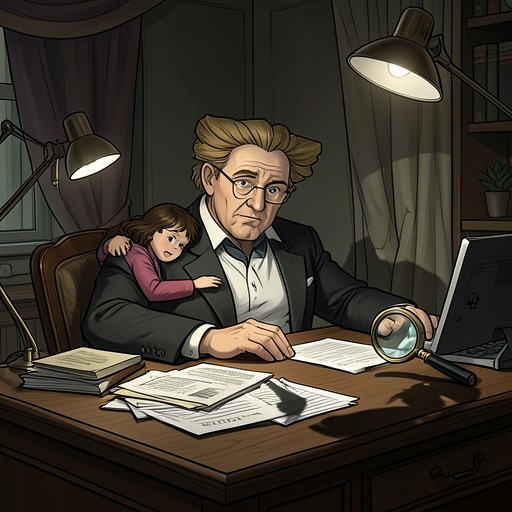
Donnelly’s discovery of discarded box files extends this preservation work from objects to the novel’s own documentary claim. He found the files on a city-centre pavement, where they had apparently been left for the Cleansing Department to destroy. They contained papers from a defunct law office, including property records and material associated with a woman doctor remembered by historians of the suffragette movement. The introduction makes Glasgow’s uneven treatment of its past part of the book’s form: the city’s records can be lost as refuse, rescued by local historians, and then used to argue over whether the story they preserve is fact or fiction. The narrator and Donnelly disagree about that question, and the narrator presents his research in Glasgow archives and libraries as evidence for a historical account.
Medical and Domestic Geography
The central story binds Glasgow’s medical world to particular addresses. On 29 August 1879, Archibald McCandless enrols as a medical student at Glasgow University, where Godwin Baxter works as an assistant in the anatomy department. The university therefore connects the young student to Baxter before their relationship becomes personal, and it places the novel’s extraordinary medical plot within an established setting of instruction and practice. Baxter’s home at 18 Park Circus is another crucial site. After the body of a pregnant woman is recovered from the River Clyde on 18 February 1881, Baxter, acting as police surgeon, certifies death by drowning. The woman is described as about twenty-five, tall, dark-haired, blue-eyed, fair-complexioned, and well dressed; no one claims her body. The introduction locates the extraordinary act that follows in Glasgow and at Baxter’s address, making a private house the threshold between civic medical authority and an experiment that unsettles ordinary accounts of life and death.
The city’s domestic spaces also become a refuge. Years later, when Victoria is mistreated by her husband and learns that he is about to have a child with a younger servant, Baxter receives her at 18 Park Circus without asking for an explanation. He asks his mother, Mrs. Dinwiddie, to treat the visitor as his sister and offers her a place to stay until she can afford a home of her own. The episode gives the house a social as well as medical function: it shelters a woman escaping a damaging marriage, and it exposes the difference between Baxter’s frank acknowledgment of his unmarried mother and the invented family story he uses to protect Victoria’s identity. Glasgow’s rooms and addresses are thus not neutral scenery; they provide the conditions under which concealment, kinship, and independence are negotiated.
Rivers, Parks, and Urban Poverty
Glasgow’s waters register the costs of industrial life. During a spell of hot, calm weather, smoke and gases hang over the valley in a gritty haze. Walking beside the Kelvin River, Archibald McCandless sees effluent from an upstream paper mill tumble over a weir in heaps of green froth. The filthy substance hides the river as it passes through West End Park, and he imagines it flowing into the oil-fouled River Clyde between Partick and Govan. This is no distant landscape: the contamination lies within a public park and beside a route used for an ordinary evening walk. The scene makes pollution part of the city’s everyday environment and brings industrial waste into the same field of vision as recreation and public health.
The Loch Katrine Memorial Fountain offers a contrasting urban waterscape. Its jets provide some freshness in the oppressive air, while well-dressed adults and children parade around it. There McCandless unexpectedly sees Bella Baxter with Godwin Baxter after a long separation. The fountain’s orderly display and momentary relief stand against the filthy foam in the nearby park, while the sudden reunion turns a familiar public place into a scene of astonishment. Glasgow’s water imagery therefore moves between pollution and civic amenity, and between the city’s material conditions and the personal memories that surface within them.
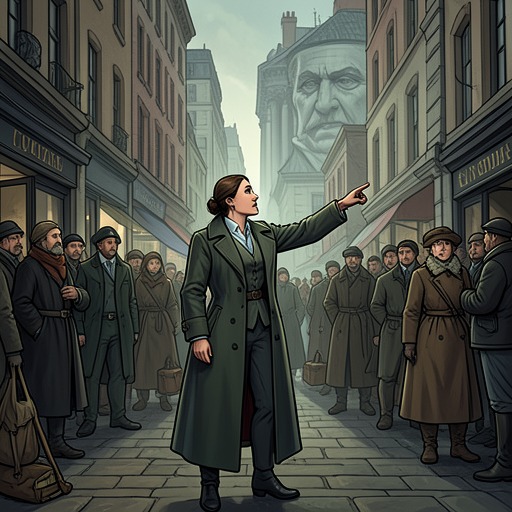
The city’s social geography becomes explicit when Bella proposes travelling to Alexandria to find and adopt a little girl and her baby brother. Baxter answers that comparable deprivation exists within walking distance: from Glasgow Cross, a walk up the High Street would pass railway yards and warehouses on the ground of the old university, then ordinary tenements and overcrowded rooms. In some closes, more than a hundred people share one communal tap for drinking and washing; in some rooms, a family occupies each corner. Dysentery, rickets, and tuberculosis are common. Baxter argues that poor children could be taken into domestic service, while Bella recoils from both the suffering and the proposal’s limits. By redirecting her attention from distant hardship to Glasgow’s own tenements, he makes the city a test of charitable intention: compassion must confront the structures and choices present at home, not only the misery witnessed abroad.
Education, Medicine, and Public Work
Glasgow is also the setting for the education and professional work through which Bella’s later identity takes shape. Baxter tells her that only four women doctors are then practising in Britain, all with degrees from foreign universities, while the Enabling Bill of 1876 and Sophia Jex-Blake’s work are opening a path for women students at Dublin University and, soon, Scottish universities. His proposed route begins not with lectures but in the charity wards of an east Glasgow infirmary: Bella would train as a nurse, and, if she succeeded, assist him as a theatre nurse before going to medical college. Baxter argues that doctors and surgeons should begin with nursing or manual work, linking professional knowledge to practical experience. Bella says she wants to help little girls, mothers, and prostitutes, and intends to teach women modern contraception; Baxter and McCandless counsel her to keep that intention private until she can practise, and to choose for herself when to argue publicly for birth control.
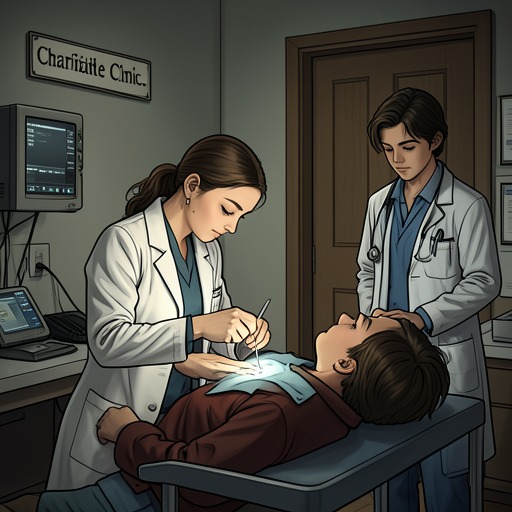
Her subsequent career remains tied to Glasgow. Under the name Victoria, she enrols in the Jex-Blake women’s medical school in Edinburgh in 1886 and receives a Doctor of Medicine degree from Glasgow University in 1890. That year she opens the purely charitable Godwin Baxter Natal Clinic in Dobbie’s Loan near the Cowcaddens, running it with a small staff of local women whom she trains herself. She encourages trained helpers to leave when they have learned what she can teach and to take their skills to neighbours or to other doctors. Some enrol as hospital nurses, although a ward sister complains that they ask too many questions. The clinic thus extends the novel’s concern with education beyond Bella: medical work is presented as knowledge that can be passed on, even when the institutions receiving her trainees do not welcome their questioning.
Bella’s professional influence eventually reaches well beyond the city, but Glasgow remains the base of her family and civic life. In McCandless’s account, he becomes chairman of the Glasgow Civic Improvement Trust, while she manages the clinic, writes Fabian pamphlets, and promotes female suffrage. Her public reputation grows across Europe and into America, whereas his self-description casts him as the quieter ballast of their marriage. The contrast places local work and international recognition in the same frame without making them equivalent: the clinic and civic trust root their public lives in Glasgow, even as Bella’s advocacy carries its arguments elsewhere.
Death, Memory, and the City’s Meaning
Glasgow’s public spaces also hold the story’s account of death. The book’s closing historical note says that Victoria McCandless is found dead of a cerebral stroke on 3 December 1946. It distinguishes the age reckoned from her brain’s birth in the Humane Society mortuary on Glasgow Green on 18 February 1880 from the age reckoned from her body’s birth in a Manchester slum in 1854. The two calculations do not resolve into a single uncomplicated biography; they preserve the novel’s division between bodily history and the extraordinary origin it assigns to its heroine. Glasgow Green, where the account locates that origin, is also named in a caption identifying the place where Lady Victoria Blessington drowned herself, the bridge from which she leapt, the wharf where Geddes saw her drown, and the Humane Society House where Baxter examined her corpse.
The city’s final memorial geography gathers the principal characters in the Glasgow Necropolis, in the Baxter Mausoleum. From rescued museum objects and discarded legal files to a clinic, a river, and a family tomb, Glasgow repeatedly turns the past into something materially present and open to interpretation. Its urban landscape sustains the novel’s tension between documentary proof and fantastic invention, while its inequalities give Bella’s medical and social commitments a local field of action. The city is at once the setting of her beginnings, the site of her work, and the archive through which later readers are asked to judge her story.